Risk and regulatory compliance becomes harder when organisations respond with extra policy, extra process and extra controls without improving how work connects across the business. This article explains the five-part compliance cycle and shows how Australian organisations can improve visibility, accountability and action.
Risk and regulatory compliance can become harder, not easier, when organisations respond by adding more policies, more controls and more process without improving how work connects across the business. The result is often slower decision-making, unclear accountability and a widening gap between what teams document and what they can actually manage in practice.
For many Australian organisations, the issue is not a lack of intent. It is a lack of structure. Risk, compliance, safety, audit and operational teams may all be working hard, but when their activities are not connected, important information gets interpreted differently, action stalls and reporting becomes reactive.
This is why the risk and regulatory compliance landscape should be understood as a cycle, not a checklist. Each part of the cycle influences the next. When one area is weak, the whole operating model becomes harder to sustain.
The five-part risk and regulatory compliance cycle
The framework can be understood in five connected parts:
- Interpretation
- Governance and operating model
- Policy, process and control
- Change and transformation
- Response and remediation
Together, these areas shape how an organisation understands obligations, embeds them into day-to-day operations, responds when issues arise and improves over time.
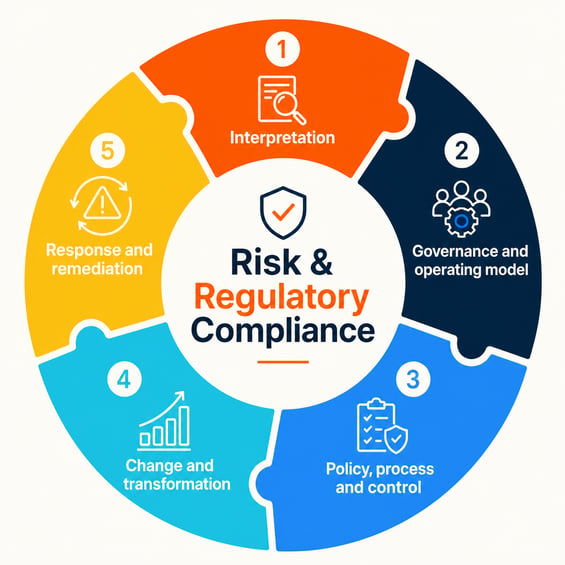
1. Interpretation: turning obligations into practical decisions
Every compliance effort begins with interpretation. Organisations must understand what a law, regulation, standard or internal requirement actually means for their people, processes and risk profile.
This is where many problems begin. If interpretation is overly cautious, inconsistent or disconnected from operational reality, businesses can create control environments that are heavier than necessary. Teams may introduce extra steps simply to feel safe, even when those steps add little value.
Poor interpretation can also create uncertainty across the organisation. Different business units may apply the same requirement in different ways. Leaders may struggle to define risk appetite clearly. Frontline teams may be left unsure about what is mandatory, what is recommended and what outcome the organisation is trying to achieve.
Good interpretation creates clarity. It links legal and regulatory obligations to business objectives, operational realities and decision-making thresholds. It gives teams practical guidance they can act on and provides Visibility For Leadership when oversight is needed.
2. Governance and operating model: defining accountability
Once obligations are understood, organisations need a governance and operating model that makes accountability clear.
This goes beyond assigning responsibility on paper. It means defining who oversees risk, who manages controls, who reviews incidents, who tracks actions and how information moves between operational teams, management and the board.
Without this structure, organisations often duplicate governance processes across functions or lines of defence. Instead of strengthening assurance, duplication creates overlap, confusion and reporting fatigue. Multiple teams may request the same information in different formats, while no one has a real-time view of what is changing.
A strong governance and operating model supports Role-Based Access, clear escalation pathways and consistent decision rights. It helps organisations move from scattered ownership to coordinated execution.
3. Policy, process and control: embedding compliance into daily work
Policies, processes and controls matter, but only when they are useful, accessible and connected to the risks they are meant to manage.
Too often, organisations respond to pressure by producing more documentation. Policies multiply. Controls are layered in. Procedures are stored in different places. Over time, the business carries a compliance burden that is difficult to maintain and even harder for employees to follow.
The issue is not control itself. The issue is controls that are hard to find, hard to interpret or disconnected from evidence and action.
Effective organisations take a different approach. They create a Centralised Repository for obligations, controls, incidents, actions and supporting evidence. They keep records Audit-Ready. They ensure Actions And Evidence Connected to a risk, issue or control review can be traced clearly. They focus on controls that support good decisions and measurable outcomes, not just documentation volume.
4. Change and transformation: making compliance part of business improvement
Regulatory change, internal transformation and operational change all place pressure on compliance systems. New products, restructures, acquisitions, digital initiatives and revised standards can quickly make older approaches unworkable.
If change programs treat risk and compliance as an afterthought, the organisation misses the opportunity to build efficient operations from the start. Teams then spend time retrofitting controls, rewriting processes and correcting issues that could have been managed earlier.
This is why change and transformation must be part of the compliance cycle. A scalable organisation needs Data-Driven oversight of change impacts, responsibilities, dependencies and emerging risks. It needs Actionable Insights into whether changes are improving control effectiveness or introducing new exposure.
When change is governed well, risk and compliance support transformation rather than slowing it down. The business becomes better able to adapt while maintaining Clear And Reliable Records.
5. Response and remediation: closing the loop when issues arise
No organisation avoids every issue. Incidents, audit findings, regulatory actions, near misses and control failures will occur. What matters is how effectively the organisation responds.
In weaker environments, responses are tactical and reactive. Teams focus on immediate closure rather than root cause, trend analysis or systemic improvement. Activities multiply, but little value is created. This can cause efficiency drag and make the organisation less prepared for the next issue.
Strong response and remediation processes do more. They connect Incident Management, investigation, corrective actions, evidence, deadlines and owners in one Secure, Accessible Platform. They make it easier to see what has been done, what remains open and whether remediation is reducing risk.
When organisations can track remediation in Real-Time, they move from reactive activity to continuous improvement.
Why organisations get stuck
More controls do not automatically produce better outcomes.
Organisations typically get stuck when:
- responses to regulatory actions are reactive and tactical
- risk appetite is poorly defined or inconsistently applied
- governance processes are duplicated across teams
- policies and controls grow faster than operational clarity
- transformation programs fail to embed risk and compliance from the start
- remediation is tracked as activity rather than measured as improvement
Each of these issues reduces productivity and makes it harder for leadership to understand the real state of risk and compliance.
What better looks like
A stronger approach is to treat risk and regulatory compliance as an integrated operating discipline.
That means creating one connected environment where interpretation, governance, controls, change and remediation inform each other. It means using Enterprise Risk Management and Incident Management practices in a way that gives the organisation a shared view of obligations, ownership, actions and evidence. It means replacing uncertainty with visibility and replacing reactive reporting with Actionable Insights.
For Australian organisations facing increasing scrutiny, this matters because compliance is no longer just about proving that a policy exists. It is about showing that the organisation can identify risk, act quickly, monitor performance and demonstrate accountability.
How integrated technology supports this cycle
The right platform helps organisations manage this cycle with greater confidence.
An AI-Powered, User-Friendly platform can support:
- consistent interpretation of obligations and internal requirements
- role-based governance and accountability
- centralised policy, process and control management
- connected incident, audit and corrective action workflows
- Real-Time reporting for management and board oversight
- scalable change tracking and compliance monitoring
- Clear And Reliable Records that are always Audit-Ready
This is especially important where safety, compliance and operational risk intersect. When teams can see how risks, incidents, controls and actions relate, they are better equipped to protect people, reputation and business performance.
Final thought
Navigating the risk and regulatory compliance landscape is not about building the biggest control framework. It is about building the clearest one.
Organisations perform better when they can interpret requirements accurately, assign accountability clearly, embed practical controls, manage change with discipline and respond to issues in a way that drives measurable improvement.
That is how compliance becomes more than oversight. It becomes a source of resilience, confidence and better operational performance.