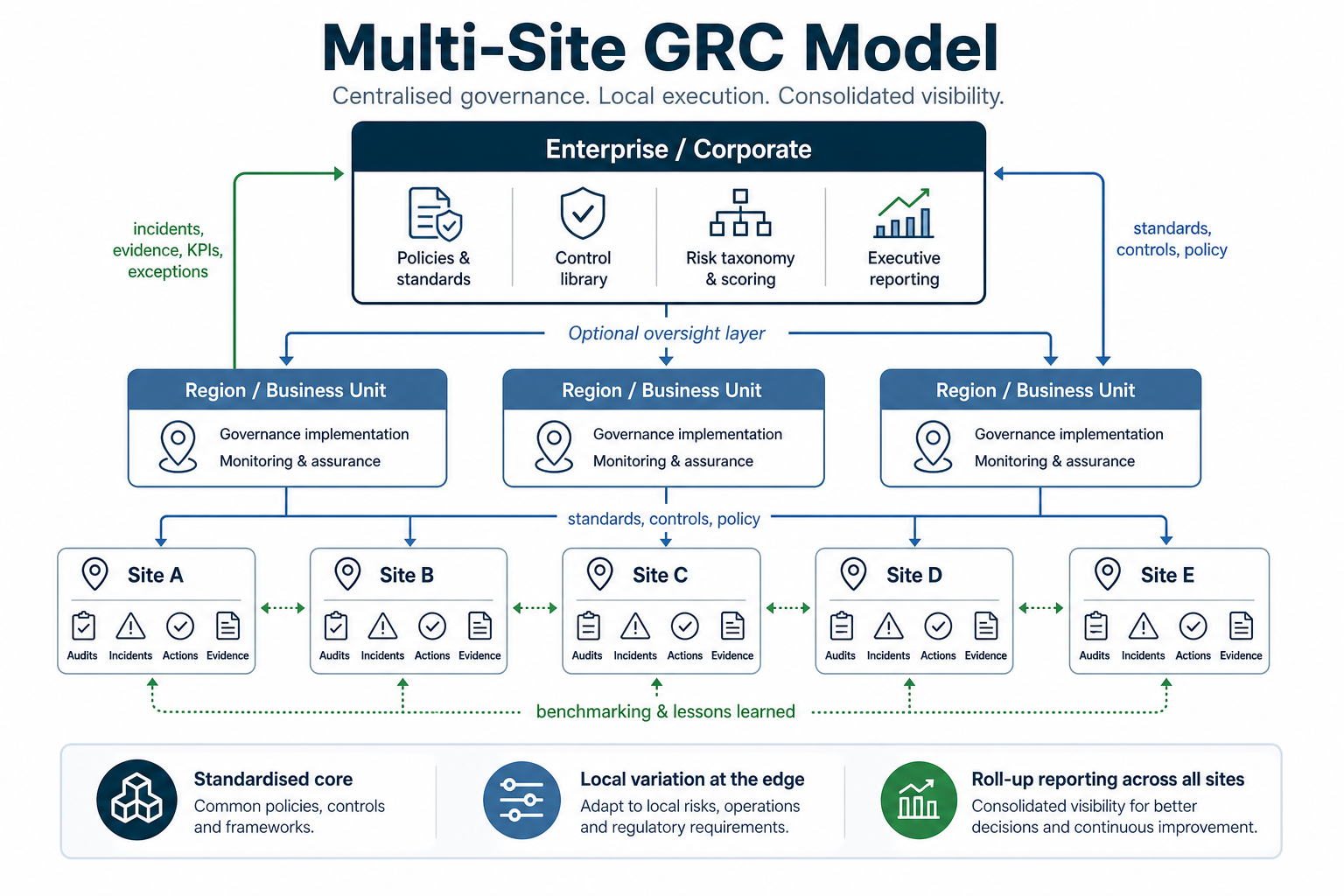
For organisations operating across multiple regions, plants, branches, franchises, warehouses or field locations, selecting a GRC platform is not simply a technology decision. It is an operational decision that affects consistency, accountability, visibility and the ability to manage risk at scale.
A system that works well for a single site can become difficult to govern when processes need to be deployed across dozens or hundreds of locations. The right platform should help organisations maintain common standards while still supporting the practical needs of individual sites.
When evaluating a GRC solution for multi-site operations, there are several areas that deserve close attention.
1. Location hierarchy and organisational structure
Multi-site organisations rarely operate in a flat structure. They often need to reflect regions, business units, countries, sites, plants, stores, franchises, departments and teams within one operating model.
A GRC platform should allow this hierarchy to be configured cleanly so that records, responsibilities, workflows and reporting can all align to the way the business actually operates. If the location model is difficult to set up or maintain, the organisation will quickly run into issues with ownership, reporting accuracy and governance.
Key questions to ask include:
- Can the platform model multiple layers such as region, site and department?
- Can records be filtered, viewed and reported by each level of the hierarchy?
- Can responsibilities and permissions be assigned at the right organisational level?
- Can the structure adapt as the organisation grows, restructures or acquires new locations?
Without a strong hierarchy model, multi-site governance becomes harder to standardise and harder to measure.
2. Standardised audits and inspections with local flexibility
One of the main goals in multi-site governance is consistency. Organisations want every site to work from the same audit and inspection standards so they can compare results, identify trends and demonstrate control.
At the same time, local sites often need practical flexibility. A plant, warehouse, retail outlet or regional office may require a site-specific question set, additional controls or different compliance references.
The right GRC solution should support both objectives. It should allow one core audit or inspection template to be reused across the organisation while enabling controlled local variations where they are genuinely needed.
Important evaluation points include:
- Can a master template be rolled out across all locations?
- Can local site questions or fields be added without rebuilding the entire template?
- Can version control be maintained so teams know which standard is current?
- Can results be compared across sites even when small local variations exist?
This balance between standardisation and flexibility is essential for multi-site audit maturity.
3. Corrective actions that are assignable, trackable and enforceable
Audit findings, incidents, hazards and compliance issues only matter if they lead to action. In a multi-site environment, corrective action management needs to be highly visible and tightly controlled.
A suitable solution should allow issues to be assigned to the right person at the right site, tracked against deadlines, escalated when overdue and supported by evidence showing what was completed. This creates accountability and helps leaders understand whether issues are being resolved effectively across the business.
When reviewing corrective action capability, consider whether the platform can:
- Assign actions by site, department, role or individual
- Track due dates, status, priority and escalation rules
- Capture supporting evidence such as photos, files, comments and sign-off
- Link actions back to audits, inspections, incidents, risks or non-conformances
- Provide management visibility into overdue or recurring issues by location
In multi-site operations, corrective action management is one of the clearest indicators of whether the platform can support real operational discipline.
4. Document and procedure rollout across all locations
Policies, procedures and standard operating instructions need to reach every site in a controlled and measurable way. It is not enough to publish a new document and assume it has been adopted.
Organisations should evaluate whether the platform can distribute updates efficiently, notify the right users, record acknowledgements and maintain confidence that each location is working from the current version.
This becomes especially important when procedures affect safety, compliance or operational quality.
Questions worth asking include:
- Can policy and SOP updates be distributed across all relevant sites from one central point?
- Can the organisation track who has viewed or acknowledged an update?
- Can different document sets be rolled out to different site types or business units?
- Is there a clear audit trail showing version history, communications and acknowledgements?
For multi-site organisations, document control is not just administrative. It is a governance requirement.
5. Offline and mobile capability for operational teams
Many multi-site organisations rely on frontline teams working in plants, warehouses, field environments, transport operations or remote locations. In these settings, desktop-first software can limit adoption and reduce reporting quality.
A GRC solution should support mobile use in a practical way, with workflows that are simple to complete in the field. Offline capability is particularly valuable where connectivity is inconsistent or where work happens in areas with weak network coverage.
This is an important area to test, not simply confirm in principle.
Evaluate whether the solution enables users to:
- Complete inspections, audits, incident reports and corrective actions on mobile devices
- Capture photos, notes, signatures and other evidence in the field
- Continue working offline and sync data when a connection becomes available
- Use mobile workflows that are quick enough for operational teams to adopt consistently
A strong mobile experience can significantly improve both participation and data quality across sites.
6. Cross-site analytics and benchmarking
One of the biggest advantages of a properly structured multi-site GRC platform is the ability to benchmark locations against each other. Leaders need to see how sites are performing, where controls are breaking down and which locations need additional support.
Cross-site analytics should make it easy to compare sites, regions or business units using a common set of metrics. The value lies not just in visual dashboards, but in the ability to identify patterns early and drive improvement.
Areas to assess include:
- Can leaders compare audit scores, incident trends, action closure rates and compliance performance across sites?
- Can reporting be filtered by region, site type, department or manager?
- Can the organisation identify high-performing sites and areas requiring intervention?
- Are dashboards useful for both operational managers and executives?
Benchmarking is critical because it turns site-level activity into enterprise-wide insight.
7. Integration with the wider enterprise environment
A multi-site organisation rarely manages governance, safety and compliance in isolation. Data often sits across ERP, HRIS, LMS, incident, EHS, ITSM and identity platforms.
For that reason, integration capability should be a serious part of the evaluation process. A GRC platform should fit into the broader operating environment so that user access, organisational data, training records, incidents and other operational information can move efficiently between systems.
Integration questions should include:
- Can the platform connect with ERP and HRIS systems for organisational and people data?
- Can it integrate with LMS platforms to support training and competency records?
- Can incident, EHS and ITSM data be aligned where processes overlap?
- Can identity systems support secure authentication and access control across distributed operations?
- Are integrations available through APIs, connectors or practical implementation services?
Good integration capability reduces duplication, supports data quality and helps maintain a single operational picture across multiple sites.
What matters most in a multi-site evaluation
The most effective GRC solution for multi-site operations is one that combines standardisation with operational flexibility. It should help the organisation apply consistent governance across every location while still reflecting the practical realities of how different sites operate.
That means looking beyond surface-level feature lists. The real test is whether the platform can support structured location hierarchies, reusable templates, accountable corrective actions, controlled document rollout, mobile execution, cross-site benchmarking and enterprise integration in one cohesive environment.
For organisations with distributed operations, these capabilities are not secondary considerations. They are central to building a system that improves visibility, strengthens accountability and helps every site work to a higher standard.
A careful evaluation against these areas will make it easier to identify a solution that supports both local execution and enterprise-wide governance.